PRJ · 2026
Application Portfolio Rationalization
A ServiceNow and CSDM practice that turns an application inventory into a portfolio you can actually make decisions about.
Spreadsheet dispositions to Ratified decisions
What it is
An application portfolio rationalization practice built on ServiceNow and the Common Service Data Model: a set of rules, registers and routine checks that turn an inventory of applications into a portfolio someone can actually make decisions about.
The problem
An application inventory drifts toward noise. Platforms get registered as applications, environments get registered three times, tools arrive with no decision about their future, and dispositions sit in spreadsheets with no evidence and no owner. Rationalization built on that data argues about the data instead of the applications.
What I built
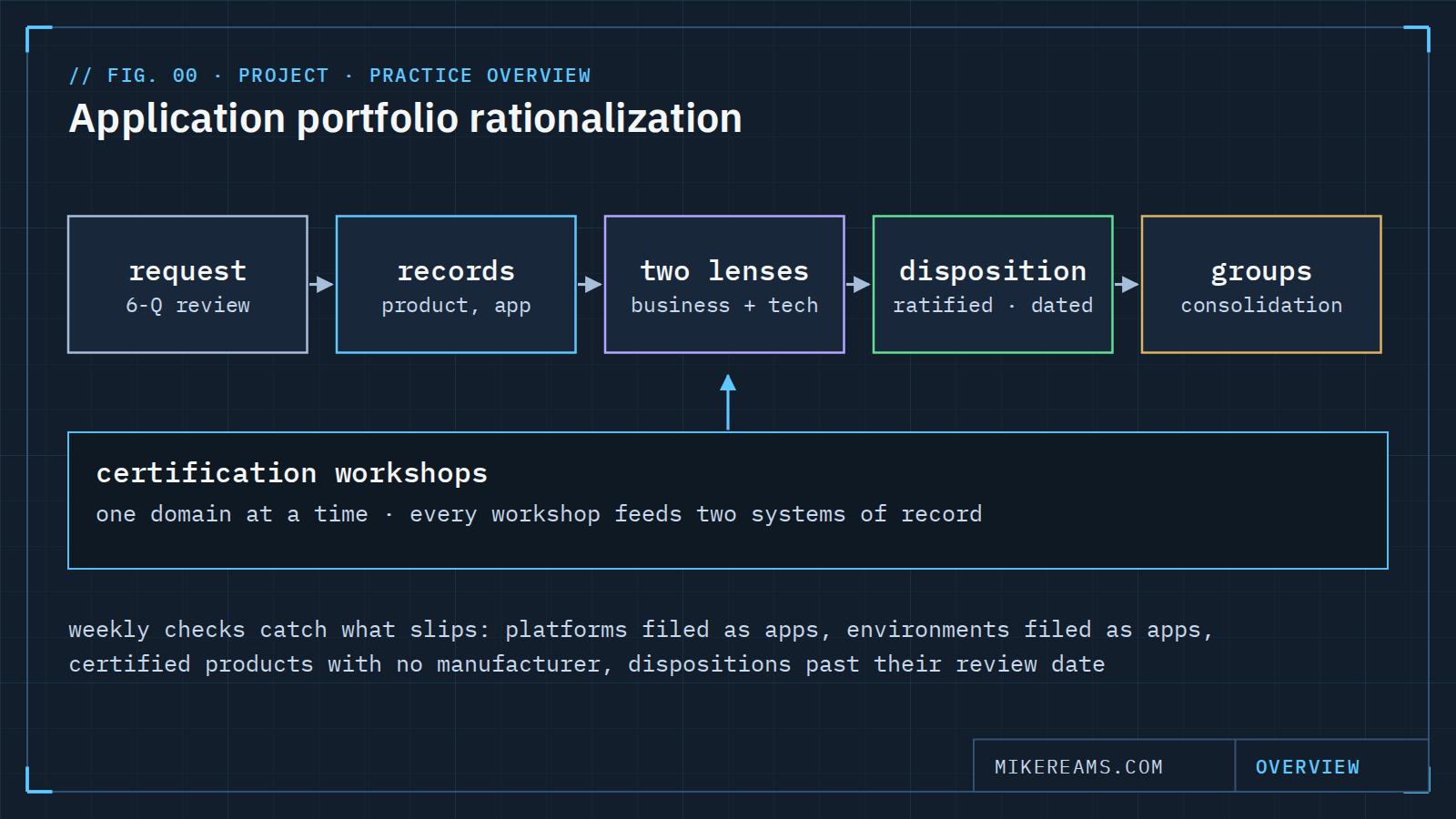
- Record rules at intake. Every technology request is reviewed against six questions that decide which records it produces, so the portfolio gets the right records at approval, not a guess at fulfilment.
- Two capability lenses. Every application maps to the Business Capabilities it serves and to exactly one technical class.
- Dispositions as decisions. TIME and 6Rs with evidence, a named ratifier, a review date and a clear source — ratified, AI-proposed or unknown — never summed together.
- Consolidation groups. Candidates tagged as a group with overlap evidence on both lenses, without naming a survivor before the decision is made.
- Contract reconciliation. Every contract export diffed and successor-traced, with one contract line mapped to one application.
- Certification workshops. One domain at a time, with each workshop feeding both the CMDB and the architecture knowledge base.
- Weekly checks. Platforms and environments filed as applications, certified products with no manufacturer, and dispositions past their review date, caught automatically and routed for correction.
What came out of it
Rationalization conversations start from records people trust. New applications enter the portfolio with owners, both capability lenses and a disposition already attached. And the portfolio's gaps are measured and tracked, not discovered in the middle of a decision.
Tools that help
Rationalization is a practice before it is a product, but the right tools keep the inventory, the assessments and the decisions in one place. These are the ones I'd look at, each with an entry in the Architect's Toolbox Guide that covers pricing, cautions and sources.
Portfolio platforms
- ServiceNow Enterprise Architecture. Formerly Application Portfolio Management, and what this practice runs on: portfolio decisions sit next to the CMDB and service records they depend on.
- SAP LeanIX. A governed application inventory with fact sheets, portfolio assessments and capability maps. Agree on what counts as an application before loading data, because pricing is per application.
- Ardoq. Applications, capabilities and dependencies in one graph, with scenarios for planning change rather than single diagrams.
- Bizzdesign Alfabet. Strategic portfolio planning that ties application and technology decisions to investment roadmaps, when funding is the main conversation.
Modeling and methods
- Blueprint Modeler. My free, browser-only canvas for drawing an application in CSDM before it goes into the CMDB, with rules that flag invalid relationships.
- BIZBOK Guide. A common vocabulary for capability maps, the business half of the two capability lenses.
- Architecture Decision Records. A short record of context, choice and consequences, which is what a ratified disposition should leave behind.
A tool holds the decisions. It doesn't make them, and it won't argue with a spreadsheet nobody trusts.