PRJ · 2026
Blueprint Modeler: A Free CSDM Architecture Canvas
A free, browser-only canvas for modeling application architecture the CSDM way, with conformance hints from public sources.
CSDM rules in a PDF to A canvas that checks them
What it is
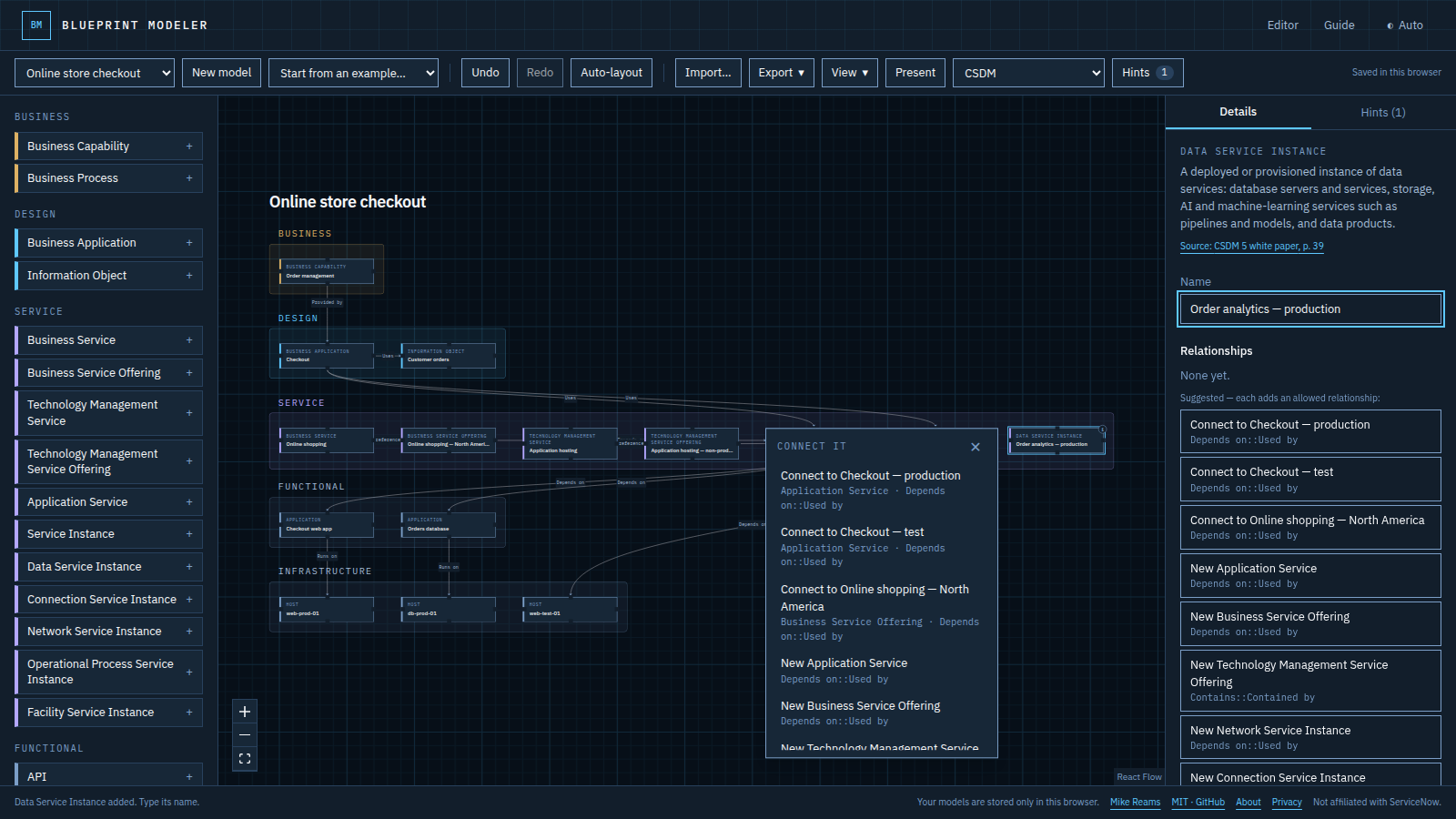
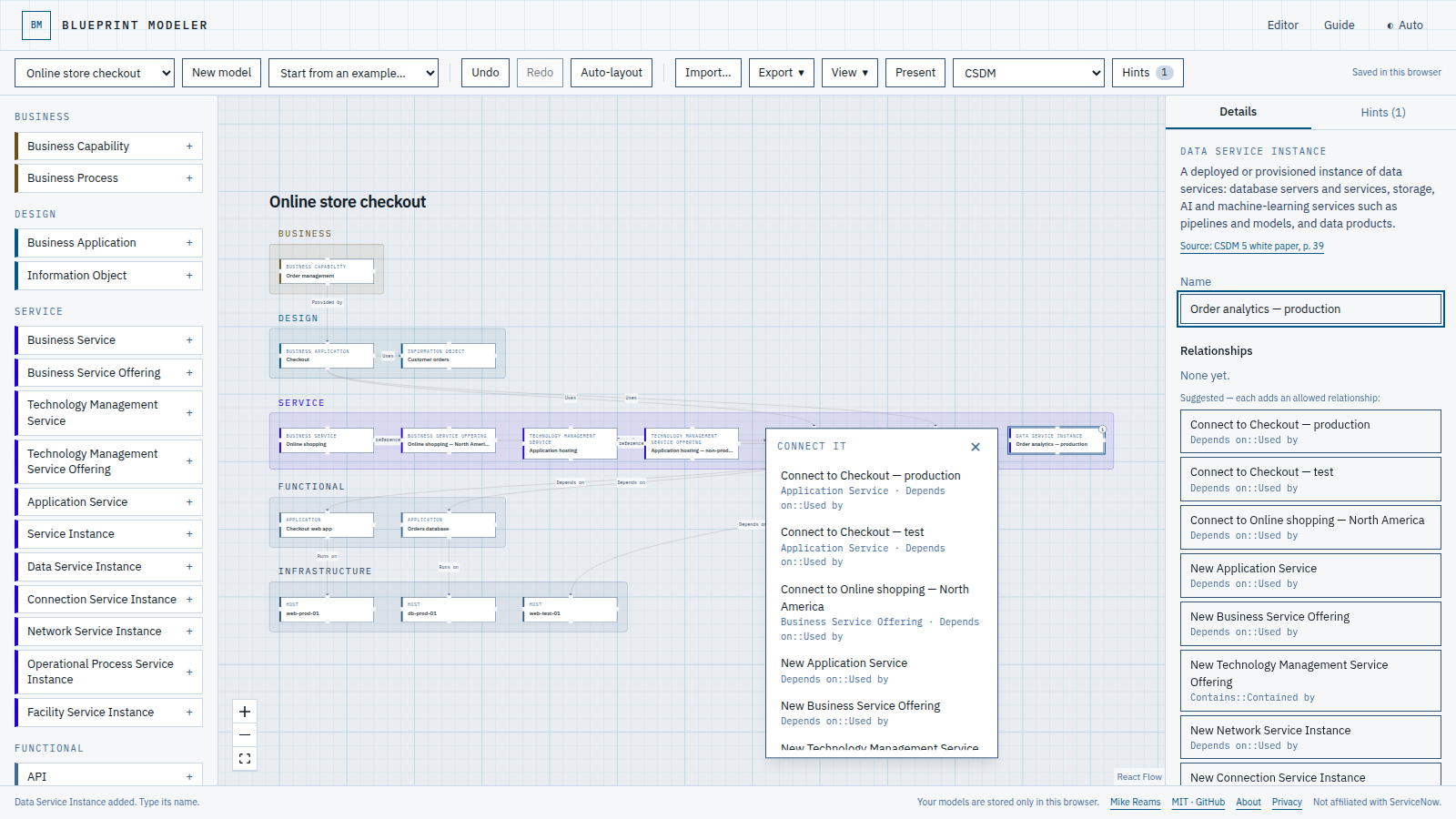
A free canvas for sketching application architecture with the Common Service Data Model: from Business Capability to Business Application, Application Service and the technology underneath. It offers only the relationships the model uses between two classes, flags common gaps as you draw, and exports a JSON file you can keep in Git or an SVG you can drop into a slide. There is no sign-up and no server. Models stay in your browser.
The problem
CSDM is how most ServiceNow shops structure their CMDB, but the rules live in a long white paper. People learning it, and architects sketching a design before anything exists in an instance, have nowhere to draw that knows the model. General diagramming tools will happily connect a Business Application straight to a server, which is exactly the shortcut CSDM exists to prevent.
What I built
- A palette by layer. Nineteen classes from the CSDM 5 white paper, including the new Service Instance family (Application Service plus Data, Connection, Network, Operational Process and Facility Service Instances), and six CMDB Kubernetes classes, marked as such. Each sits in a lane, from business at the top to infrastructure at the bottom.
- Allowed relationships only. Connect two elements and you get the type the model uses for that pair, taken from the white paper's relationship figure where it names one. While you drag, every element you can drop on is outlined, and the line turns green with the relationship type over a valid target, or red with the reason over an invalid one. A new element suggests what it can connect to and adds the element and relationship in one click.
- Conformance hints. Ten checks, such as a Business Application with no Business Capability, a service instance nobody can request, an offering with no parent service, or a capability hierarchy deeper than six levels. Each hint advises rather than blocks, highlights the elements involved, and links to its source.
- A class guide. Every class, relationship and hint on one page, with its source and how well the public text supports each relationship type.
- Layers you can work with. A translucent box around each layer, optional lanes and snap to grid. Drag a layer's label to move it with everything in it, right-click anything for the actions that fit it, and present the model full screen, one layer at a time.
- Import, export and auto-layout. Model files round-trip exactly, images export in light or dark, and one click lays the model out by CSDM layer in a background worker.
- An ArchiMate lens. Switch the lens and every element also shows the ArchiMate® element it maps to, with its notation icon. Export the model as an ArchiMate exchange file and open it in Archi or another ArchiMate tool.
Clean-room by design
Every rule comes from ServiceNow's public material, mainly the CSDM 5 white paper and the product documentation for the Kubernetes classes, and is written in my own words with a link back to the page it came from. Where the public text names a relationship type, it is marked as reported; where it only establishes the pairing, the type is marked as a conventional suggestion. The app never connects to an instance and contains nothing from any employer or customer.
How it is built
A static Next.js site on Vercel with React Flow for the canvas and elkjs for layout. There is no backend: storage is IndexedDB in the browser, and the only third-party request on the live site is a cookieless analytics beacon. Tests gate every deploy, including an accessibility pass in both themes on every page, a check that nothing loads from another origin, and layout checks across five screen widths.
Try it
Open it at model.mikereams.com and start from one of the five examples. The source is on GitHub under the MIT license.